

Black Mental Health Matters
For people who experience a mental health problem, the shame and silence can be as bad as the symptoms themselves. Your attitude to mental health could change someone’s life.
Tips for Talking about Mental Health
You might have noticed signs and behaviours which make you worried. They might seem distracted or absent, or you might not have heard from them in a while. It could be nothing, but it might be a sign that they’re not well.
Five tips for supporting someone
1. Start a conversation
If you’re concerned about someone, the first thing to do is to check in. It can be as simple as a text: just make sure they know you really want to know how they’re doing.
2. Listen and reflect
Give the person space to explain what they’re going through. Try not to make any assumptions about their experience based on other things you’ve seen and read. Asking open questions can be helpful: these are questions that invite people to expand, rather than respond with just ‘yes’ or no.
Examples of open questions include:
“How have you been feeling?”
“What’s that like for you?”
3. Be patient
It might take a while for the person to feel comfortable talking about what they’re going through, or there might be periods where they’re less communicative. That’s understandable: sometimes, if you’re experiencing a mental health problem, it’s harder to be sociable.
It might feel frustrating if you’re putting in effort, but try and be patient. They probably appreciate you being in touch even if they’re not responding.
4. Be yourself
Even if they’re having a hard time, they’re still the same person you know and love. Don’t treat them differently – keep including them in social activities and offer to do the things you’d normally do with them.
5. Ask how you can help
Give them space to say what they need from you. This might be a regular check-in, a particular activity, or help with practical things. Mental health problems can be draining, so they might be finding it hard to keep up with everyday tasks. If it seems appropriate, anything you can help with.

Mental Health Awareness Education
Culturally informed mental health support including workshops, seminars, webinars, information, referral, and mental wellness awareness education for African Caribbean and Black (ACB) community members.

How can I monitor my mental health and when should I be concerned?
Each person will react differently to situations, what you need to understand isn’t what’s “normal” but rather what’s healthy for you.
- Keep an eye on how you’re feeling or what might trigger negative responses.
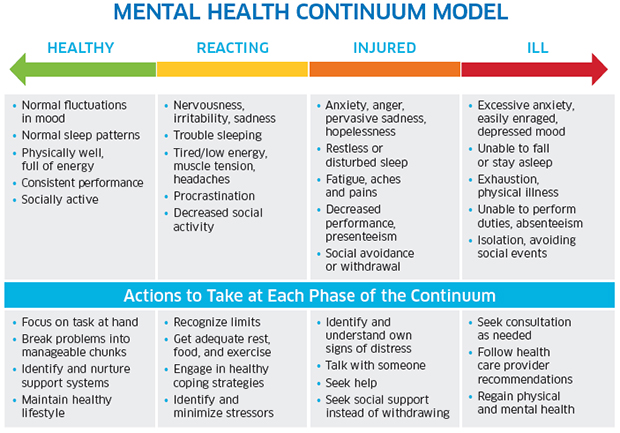
- The Mental Health Commission of Canada also has a great resource, called the mental health continuum model.
- It’s a simple tool that presents a series of emotional, cognitive, behavioural, physical, and substance use indicators.
- These indicators can be used to measure positive-through-deteriorating-to-poor mental health, and changes in personal functioning.
Colour-coded as green (healthy), yellow (reacting), orange (injured) and red (ill), the indicators are paired with their corresponding colours to help you understand when it might be time to ask for help. (Mental Health Commission of Canada).
One step away from your journey
Fear, stigma and lack of culturally sensitive treatment can act as barriers to accessing mental health care. There are various resources available to help you overcome any barriers.
What do I do if I’m worried about my mental health?
It is important to talk to someone you trust and your doctor. In addition to talking to someone, it may be useful to find out more information about what you are experiencing.
Mental Health & Stigma
For people who experience a mental health problem, the shame and silence can be as bad as the symptoms themselves. Your attitude to mental health could change someone’s life.


Are rates of mental illness different for African, Caribbean and Black (ACB) people?
People of all race and cultures experience mental health conditions, and Black individuals experience mental health challenges at rates similar to other groups. However many studies show 25% of ACB people seek mental health treatment when needed, compared to 40% of white people.
What are the barriers facing African, Caribbean and Black (ACB) people in accessing mental health services?
Some barriers are health inequities, economic disparities, cultural stigma, racism, the lack of culturally informed mental health professionals and the need for more ACB Mental Health Professionals.
It is very important to have more ACB mental health professions, and that all counsellors be culturally informed.
Name calling and other hate crimes can be easy to identify, but racism is often experienced in more subtle ways in daily interactions.
Race and racism may not be the main reason a client seeks out a counsellor, yet they could be significant contributing factors, and if counsellors are not working from a culturally informed perspective, they may be unprepared when reports of racial stress and trauma come up and do harm rather than help.